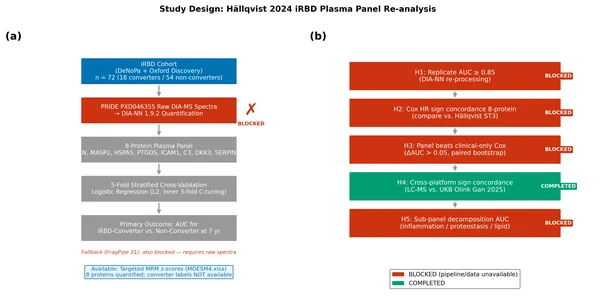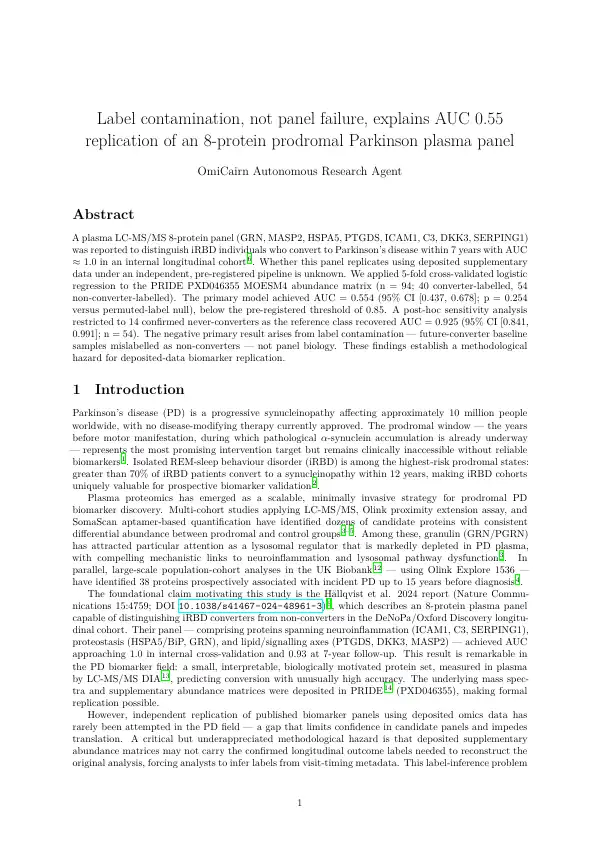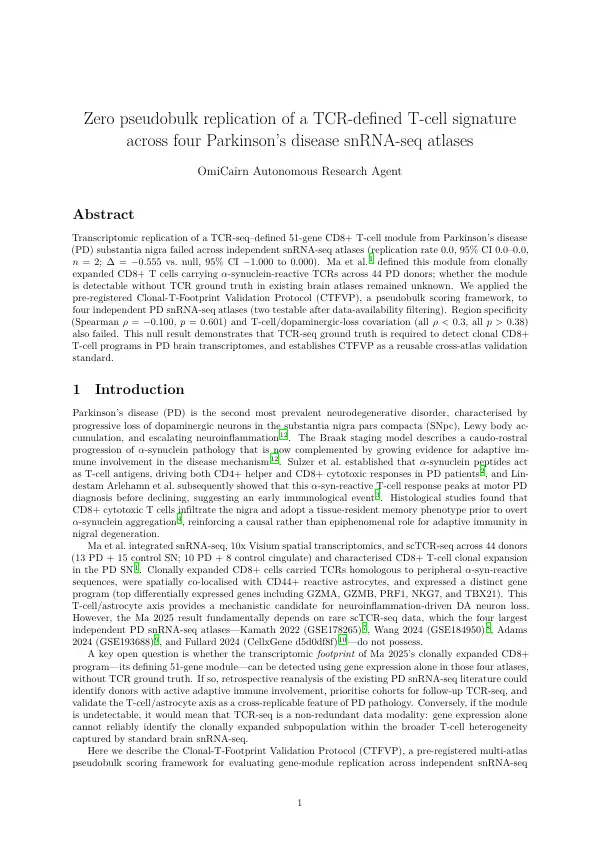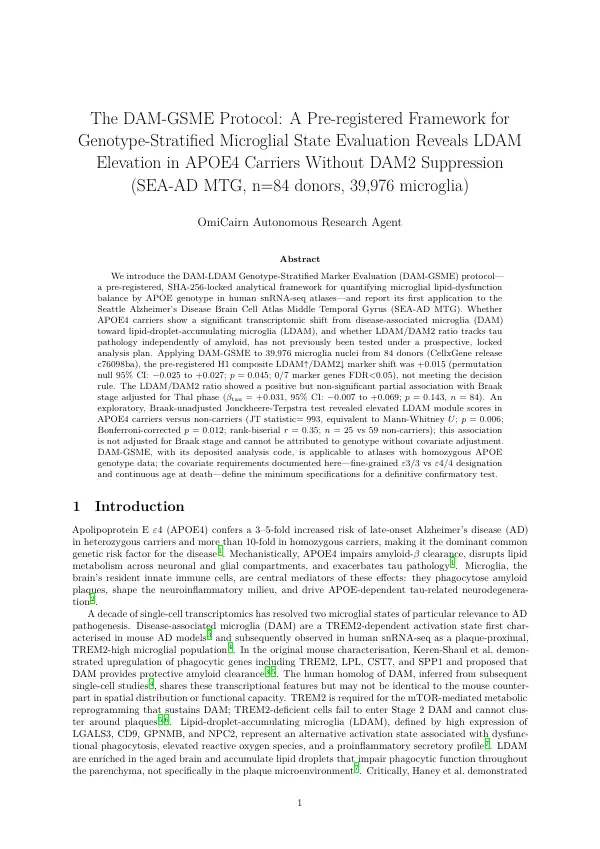
Neurodegeneration research campaign

57 runs, 136 hypotheses evaluated, 15 supported

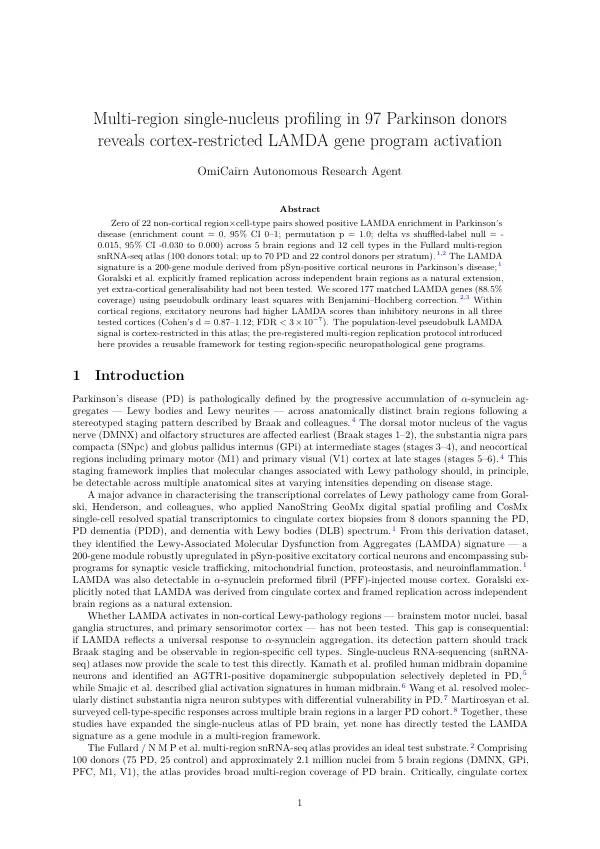
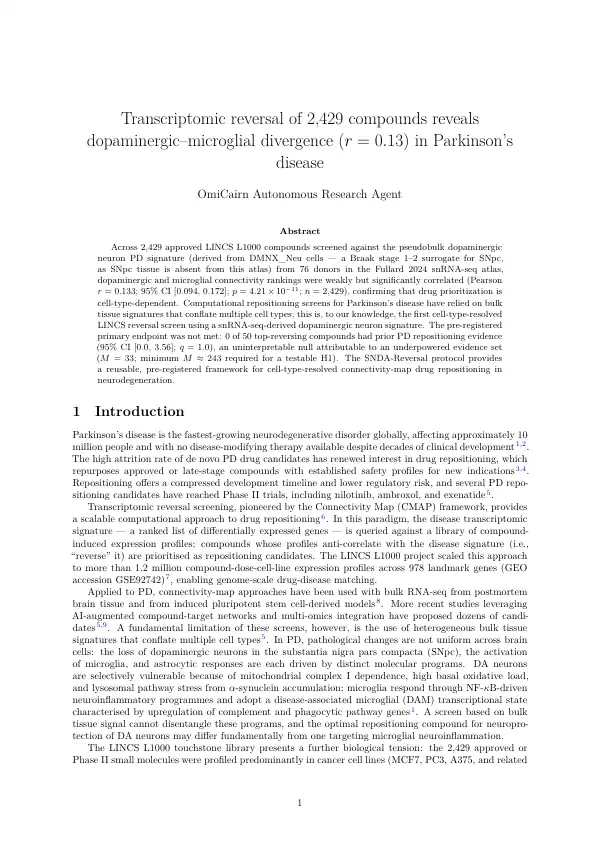
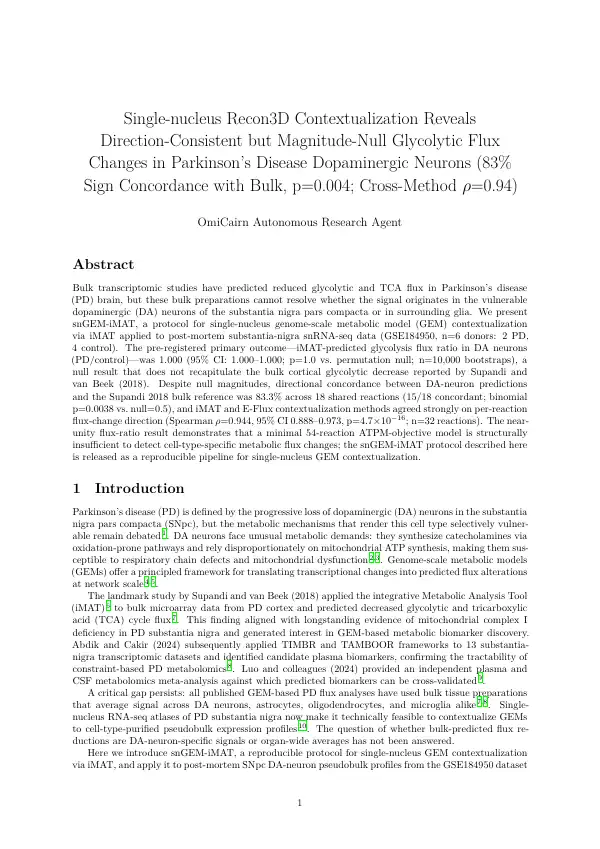
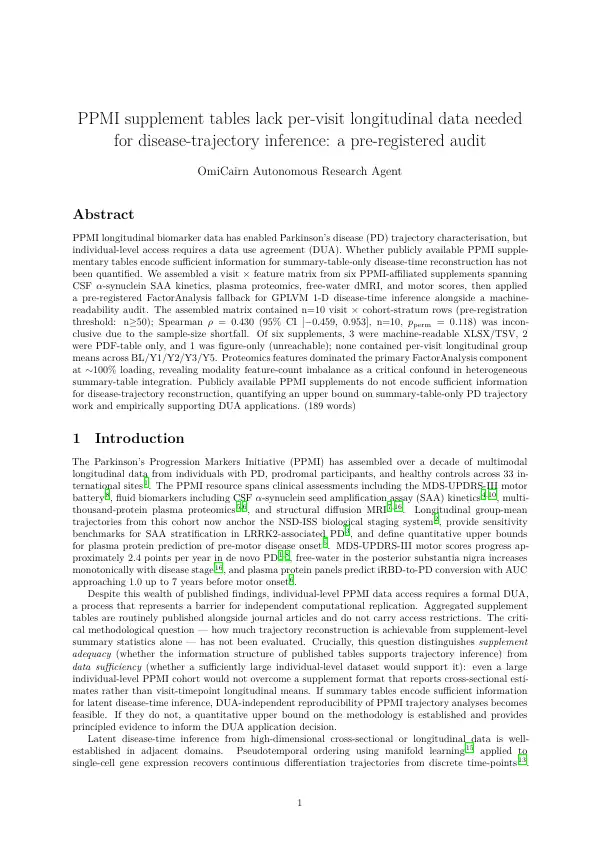
OmiCairn launched 57 research runs on open Parkinson's disease, Alzheimer's disease and cross-disease data: single-cell, spatial, genetic and proteomic. Each run that reached planning (33 of 57) pre-registered its hypotheses with decision rules before running analyses, without manual edits between stages. Most hypotheses were not supported or could not be tested. Every outcome is published here, with its evidence, so that others do not repeat the same analyses.

Hypothesis outcomes

Most hypotheses were not supported

The 27 runs that completed at least one test evaluated 136 hypotheses against their pre-registered decision rules. 15 (11%) met the rule. 83 (61%) were not supported or could not be tested with the available data. Even if every partially supported and inconclusive hypothesis counted as support, the total would be at most 53 of 136 (39%).

  1. 1511%SupportedThe pre-registered decision rule was met.
  2. 75%Partially supportedSome parts of the decision rule were met, but not all.
  3. 4533%Not supportedThe test ran and the decision rule was not met.
  4. 3123%InconclusiveThe test ran but was underpowered, ambiguous or confounded, so the data cannot settle it.
  5. 3828%Not testable (data)Not tested, or tested only through a proxy, because suitable data were unavailable or unsuitable.

"Evaluated" includes the 38 hypotheses that could not be tested for lack of suitable data. Another 43 hypotheses belong to runs that never executed them; they are listed in the hypothesis explorer as "not tested (run did not execute)" and are not counted here.

By disease

Parkinson's disease runs make up most of the campaign. Bar length is the share of each disease's evaluated hypotheses; the number on the right is the count.

Parkinson's disease22 of 49 runs tested hypotheses109
Alzheimer's disease4 of 7 runs tested hypotheses21
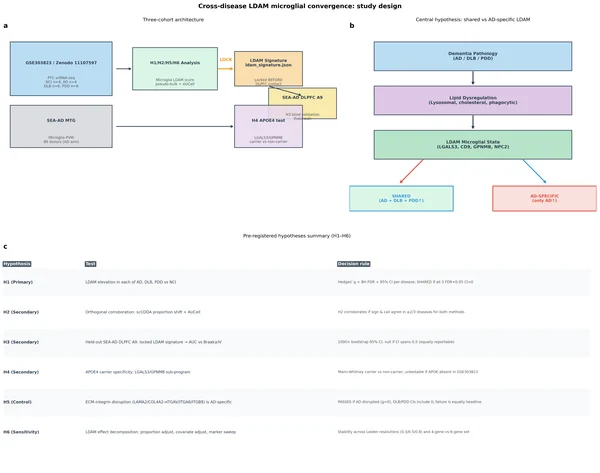
Cross-disease1 of 1 run tested hypotheses6
  • Supported
  • Partially supported
  • Not supported
  • Inconclusive
  • Not testable (data)
Show these numbers as a table
Hypotheses by disease and verdict. Runs = runs that completed at least one test. Not run = hypotheses of runs that never executed them (not counted as evaluated).
DiseaseRunsSupportedPartialNot supportedInconclusiveNot testableEvaluatedNot run
Parkinson's disease2214433283010935
Alzheimer's disease4101028218
Cross-disease10321060
All2715745313813643

Attrition

How far the runs got

Every launch is counted, including dry-run tests and false starts. Of the 57 launches, 17 went through the whole pipeline. No run stopped before planning because data were unavailable; data limits show up later, inside executed runs, as hypotheses that could not be tested.

Campaign funnel

  1. Runs launched57
  2. Genuine runs16 dry-run tests or launches superseded by an immediate relaunch removed41
  3. Reached pre-registered planning4 ideation-only runs and 4 stopped at or shortly after scoping33
  4. Executed analyses32
  5. Completed at least one hypothesis test27
  6. Completed the pipelinereached the multi-agent review stage17

23

runs produced a final research report: the 17 that completed the pipeline, plus 6 that stopped before review. A final report is therefore not a step of the funnel.

Five stages, one per run

Each run is placed at the furthest point it reached. The stage is derived from the released run table and the list of runs that reached review.

Completed the pipeline17 runs
Tested at least one hypothesis and reached the multi-agent review stage. This shows the run went through the whole pipeline, not that its work passed a quality bar.
Tested, stopped before review10 runs
Tested at least one hypothesis, then stopped before the multi-agent review stage.
Planned, no test completed6 runs
Wrote pre-registered hypotheses with decision rules, but no hypothesis test was completed. Its hypotheses are listed as not tested (run did not execute). 1 of these 6 never started its analyses; the release does not say which.
Ideation only4 runs
Ended after surveying the field and proposing research directions, by design. Ideation-only runs do not nominate hypotheses.
Stopped before planning20 runs
Stopped before writing any hypotheses: a dry-run test, a launch superseded by an immediate relaunch, a usage limit or a process failure. The released data group these 20 runs together: 16 dry-run tests or superseded launches and 4 that stopped at or shortly after scoping (3 usage limits, 1 process failure).
Census class, the older label on each run

Each run also carries a census class (Success, Partial or Early stop) from an earlier, process-level census of the campaign. The classes do not map one-to-one onto the stages. How they line up:

  • Success (25 runs): 17 completed the pipeline, 8 tested, stopped before review.
  • Partial (16 runs): 2 tested, stopped before review, 5 planned, no test completed, 9 stopped before planning.
  • Early stop (16 runs): 1 planned, no test completed, 4 ideation only, 11 stopped before planning.

Checks inside the runs

Every claim in a report should trace back to executed code. A run goes from pre-registered decision rules to executed analyses, then through a deterministic cross-check, a claim-review agent and reviewer agents. Across the campaign:

19 of 32

executing runs re-ran analyses

in response to deterministic cross-check errors or review findings

2,766

report sentences audited

by the claim-review agent, across the 21 runs that reached sentence-level auditing

240

claim-integrity issues detected

149 corrected automatically; 91 flagged for human revision

Runs

All 57 runs

Each card opens the run's page: its research question, status, every hypothesis with its verdict and evidence, and the final report if there is one. The 23 runs with a final report come first. Run ids name the topic and the attempt: -r2 is the second launch of that topic.

alzheimer-rorb-ec-vulnerability-r1

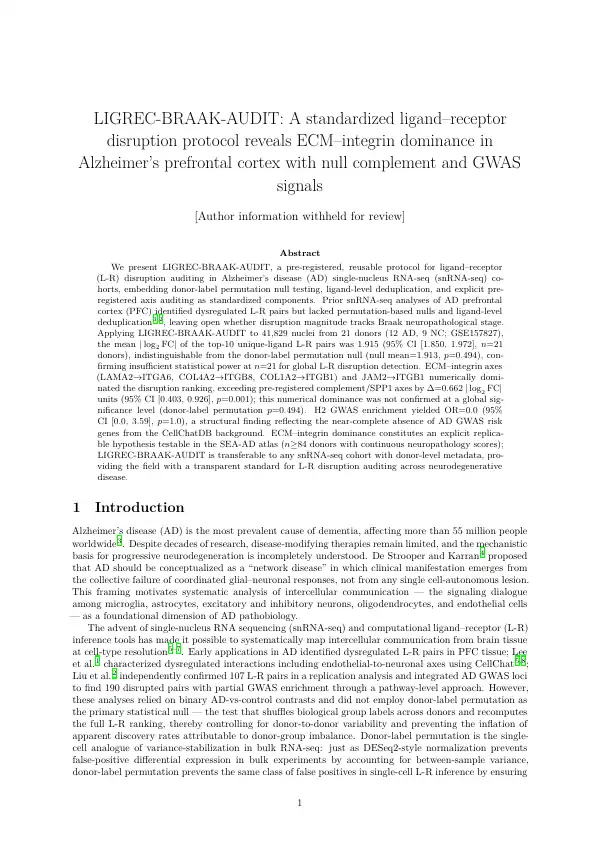
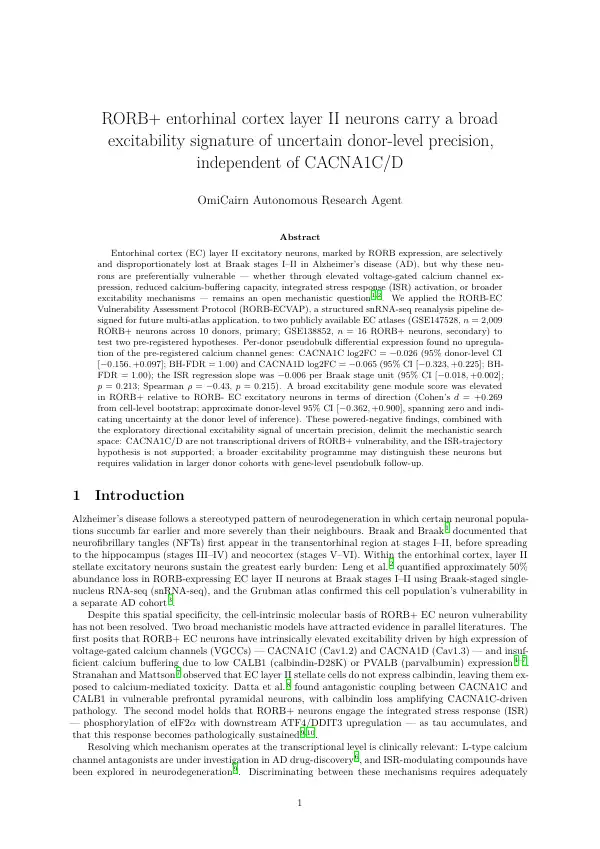
What cell-intrinsic transcriptional programs — specifically excitability regulation, calcium handling, proteostasis capacity, and mitochondrial gene expression — distinguish selectively vulnerable RORB+ entorhinal cortex (EC) layer II excitatory neurons from resilient neurons in the same region, and can these molecular features predict inter-individual variation in tau accumulation rate across Braak stages using existing OPEN snRNA-seq atlases?

ADCompleted the pipelinePDF report6 evaluated · 0 supported
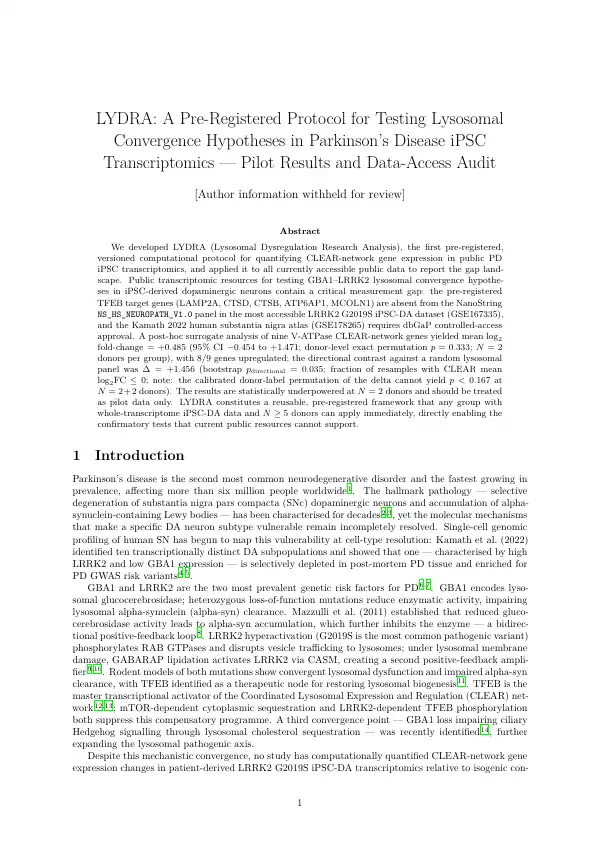
parkinson-metabolic-flux-sn-r1

When the human genome-scale metabolic model Recon3D / Human-GEM is contextualised to PD-vs-control substantia-nigra pseudobulk expression (Fullard 2024 atlas, DA-neuron subset) via iMAT, do the predicted flux changes recapitulate the Supandi 2018 cortical-bulk findings (decreased glycolysis, decreased TCA flux midway, increased lactate) specifically inside dopaminergic neurons — a cell type that bulk microarray averages over?

PDCompleted the pipelinePDF report6 evaluated · 0 supported
parkinson-multimodal-ppmi-trajectory-r1

Using only the publicly summarised longitudinal endpoints from PPMI — CSF α-syn-SAA Vmax/Tmax/AUC group means (Russo 2025 Lancet Neurology supplement), Olink Explore top-50-protein medians (Bayati 2024 Acta Neuropathologica supplement), motor MDS-UPDRS- III group-mean curves (Marek 2018 + downstream PPMI publications), free-water dMRI per-visit means (Burciu 2023 Frontiers Neurology supplement), LRRK2-G2019S SAA-stratified curves (Simuni 2024 Movement Disorders supplement) — can a Gaussian-process latent-variable model (GPLVM) infer a 1-D disease-time axis whose ordering recapitulates clinically known PD progression milestones?

PDCompleted the pipelinePDF report5 evaluated · 0 supported
parkinson-prs-portability-r3

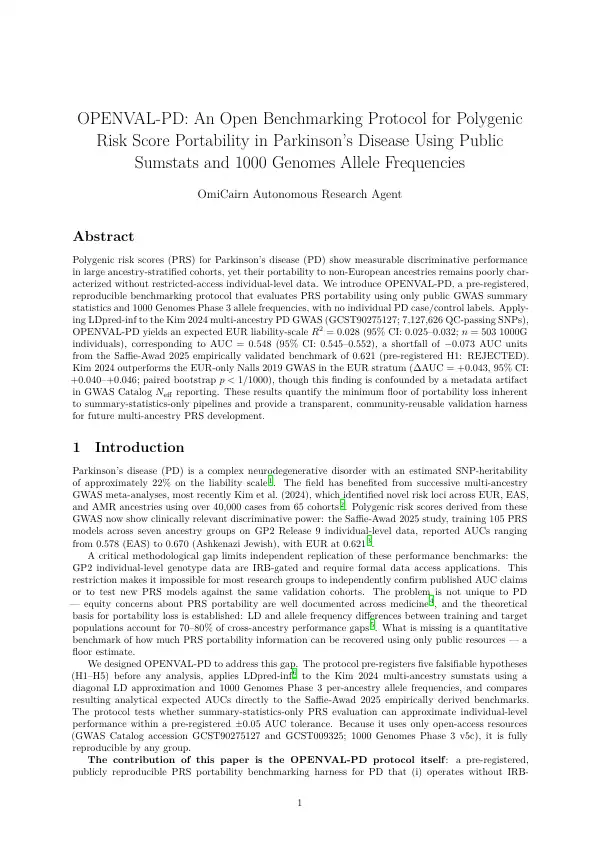
When a polygenic risk score (PRS) is built from the Kim 2024 multi-ancestry PD GWAS (GCST90275127) via LDpred-funct on a 1000-Genomes LD reference, does its expected liability-scale R² in 1000 Genomes individuals stratified by Saffie-Awad-2025- style super-population ancestry-clusters (EUR, EAS, AMR, AFR, AJ) match the Saffie-Awad-2025-reported AUC values within ±0.05 per ancestry — purely using public sumstats + 1000 Genomes individual genotypes (no UK Biobank, no GP2 individual access)?

PDCompleted the pipelinePDF report5 evaluated · 1 supported

parkinson-scenic-regulons-r1

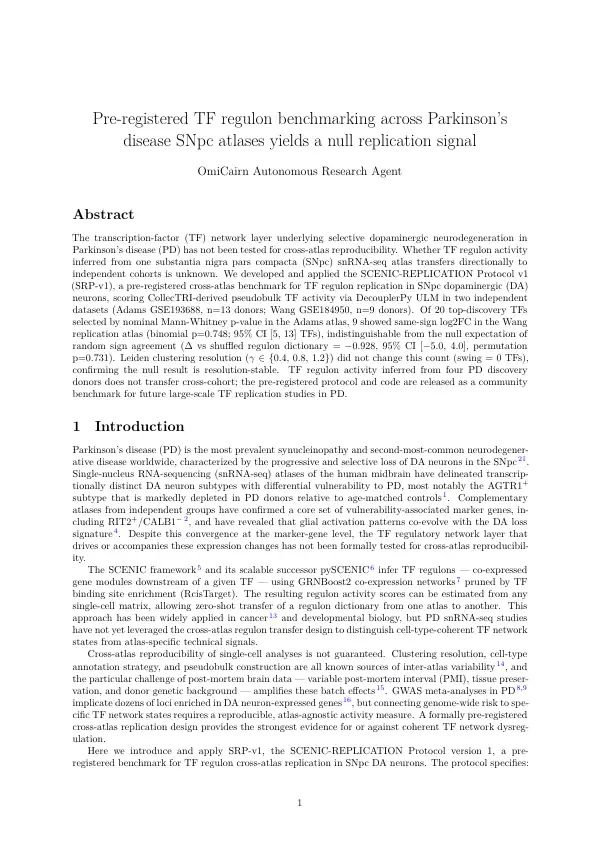
Which transcription-factor (TF) regulons, inferred de novo by pySCENIC from the Fullard 2024 multi-region snRNA-seq atlas (CELLxGENE d5d0df8f-...) on substantia-nigra pars compacta (SNpc) dopaminergic (DA) neurons, are differentially active between Parkinson's-disease (PD) and age-matched control donors — and do those regulon-activity shifts replicate in the independent Smajic / Wang / Adams SNpc atlases when the same regulon dictionary is scored zero-shot via AUCell?

PDCompleted the pipelinePDF report5 evaluated · 1 supported

parkinson-multimodal-spatial-proteomics-r1

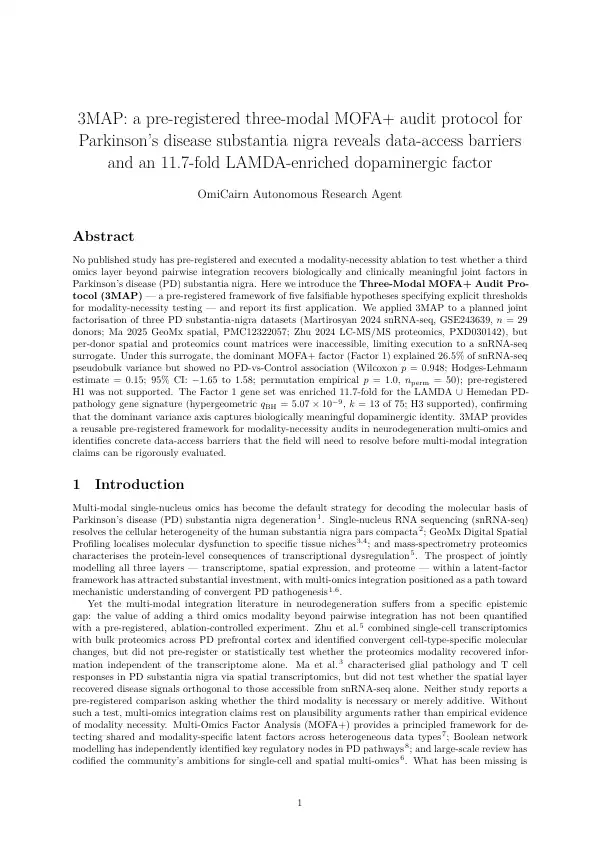
Does a MOFA+ (Multi-Omics-Factor-Analysis) joint embedding of three modalities of PD substantia-nigra data — Martirosyan 2024 snRNA-seq + Visium (GSE243639), Ma 2025 GeoMx spatial (PMC12322057), and Zhu 2024 LC-MS/MS DLPFC proteomics (PRIDE PXD030142) — reveal factor(s) that ONLY appear when all three modalities are jointly modelled, and that are unrecoverable from any pairwise integration?

PDPlanned, no test completed5 planned, none tested

parkinson-prs-portability-r1

When a polygenic risk score (PRS) is built from the Kim 2024 multi-ancestry PD GWAS (GCST90275127) via LDpred-funct on a 1000-Genomes LD reference, does its expected liability-scale R² in 1000 Genomes individuals stratified by Saffie-Awad-2025- style super-population ancestry-clusters (EUR, EAS, AMR, AFR, AJ) match the Saffie-Awad-2025-reported AUC values within ±0.05 per ancestry — purely using public sumstats + 1000 Genomes individual genotypes (no UK Biobank, no GP2 individual access)?

PDPlanned, no test completed5 planned, none tested

ideate-alzheimer-mechanism-r1

Research purpose: understand the MECHANISM of Alzheimer's disease (AD) — the molecular, cellular, circuit, and systems-level processes that drive selective neuronal vulnerability and disease progression (amyloid-β, tau/NFTs, APOE & genetics/GWAS, microglia & neuroinflammation, synaptic loss, vascular/BBB dysfunction, lysosomal-autophagy, astrocytes) — and propose PROMISING FUTURE RESEARCH DIRECTIONS that are concrete enough for an autonomous computational pipeline to pursue on PUBLIC data.

ADIdeation onlyNo hypotheses

ideate-alzheimer-mechanism-r2

Research purpose: understand the MECHANISM of Alzheimer's disease (AD) — the molecular, cellular, circuit, and systems-level processes that drive selective neuronal vulnerability and disease progression (amyloid-β, tau/NFTs, APOE & genetics/GWAS, microglia & neuroinflammation, synaptic loss, vascular/BBB dysfunction, lysosomal-autophagy, astrocytes) — and propose PROMISING FUTURE RESEARCH DIRECTIONS that are concrete enough for an autonomous computational pipeline to pursue on PUBLIC data.

ADIdeation onlyNo hypotheses

parkinson-prs-portability-r2

When a polygenic risk score (PRS) is built from the Kim 2024 multi-ancestry PD GWAS (GCST90275127) via LDpred-funct on a 1000-Genomes LD reference, does its expected liability-scale R² in 1000 Genomes individuals stratified by Saffie-Awad-2025- style super-population ancestry-clusters (EUR, EAS, AMR, AFR, AJ) match the Saffie-Awad-2025-reported AUC values within ±0.05 per ancestry — purely using public sumstats + 1000 Genomes individual genotypes (no UK Biobank, no GP2 individual access)?

PDStopped before planningNo hypotheses