Case 2 · Cross-organ fibrosis

One question, two prompts: where the answers agreed, and where they did not

We asked OmiCairn the same fibrosis question twice: once as a single sentence, once as a detailed expert prompt. Both runs found conserved fibroblast matrix programs. They disagreed on the macrophage program and on the three-cell niche. The stricter, expert-specified criteria overturned the looser claim.

Agreed

  • Fibroblast ECM and matrix programs rise in fibrosis across organs.
  • An SPP1+/TREM2+ macrophage state is present in several organs.

Disagreed

  • Whether that macrophage program is conserved across organs.
  • Whether a conserved three-cell niche co-localizes across organs.
  • Whether there is one universal fibrosis program.

8 of 32

distinct findings shared (25%)

1 Input

The two prompts

The research direction was the same. What changed was how much the user specified up front.

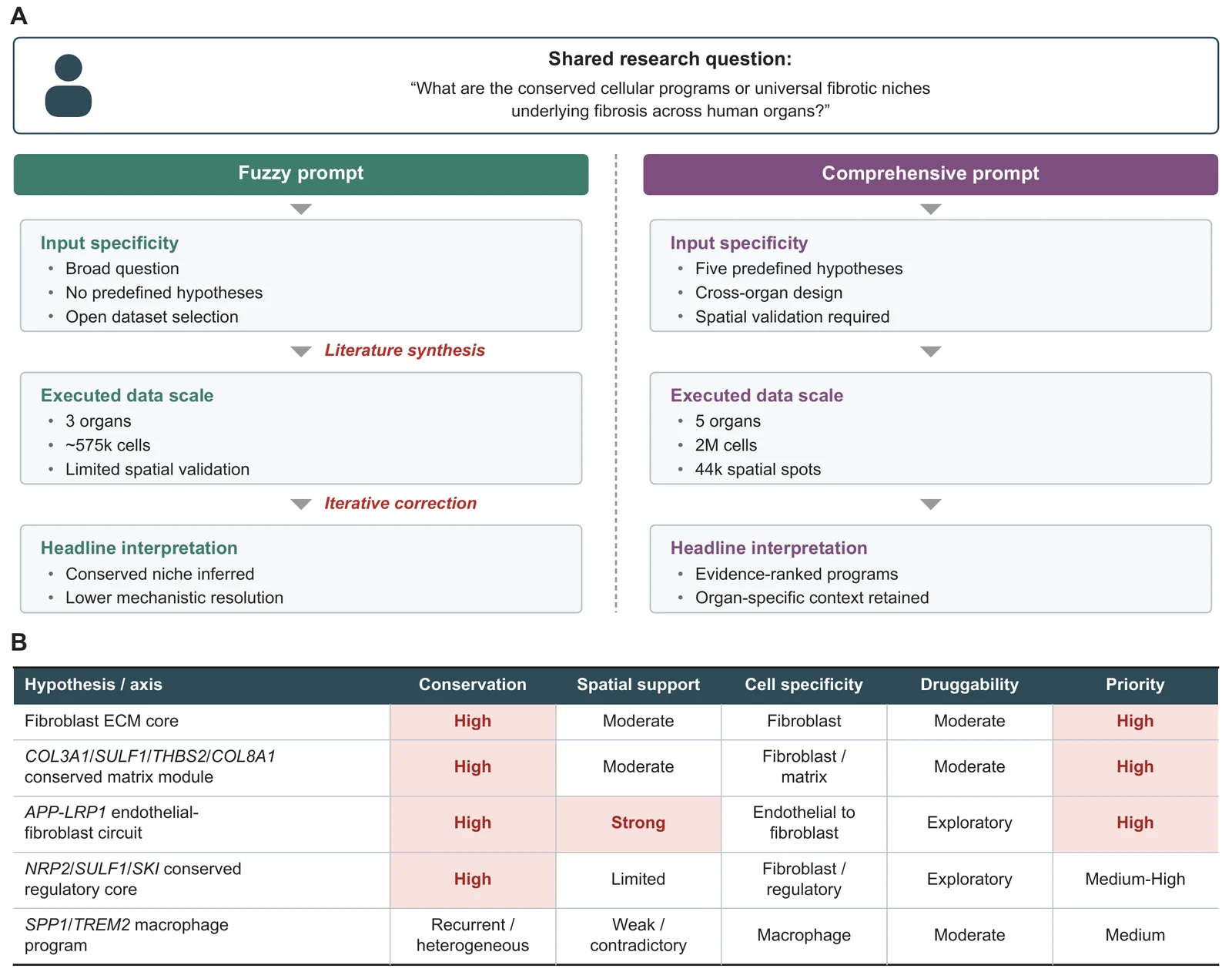
Fuzzy prompt

Fuzzy prompt

“What are the conserved cellular programs or universal fibrotic niche underlying fibrosis across human organs?”

  • One broad question
  • No predefined hypotheses
  • Open dataset selection

The kind of question an exploratory or wet-lab user might start with.

Comprehensive prompt

Comprehensive prompt

“Research goal: Identify conserved cellular programs and recurrent multicellular fibrotic niches underlying fibrosis across human organs.”

  • Competing hypotheses required (the run tested five, H1–H5)
  • Cross-organ design: lung, liver, kidney, heart and skin when available
  • Spatial validation of niches wherever spatial data exist
  • Nine required tasks, a list of expected outputs, and explicit constraints

The kind of prompt a computational expert might write.

Read the full comprehensive prompt

Research goal: Identify conserved cellular programs and recurrent multicellular fibrotic niches underlying fibrosis across human organs.

You are asked to act as an omics co-scientist. Starting from this research goal, generate a hypothesis-driven discovery workflow to determine whether human fibrotic diseases across different organs share conserved cellular states, signaling circuits, and niche architectures.

Datasets and scope: Analyze available human single-cell or single-nucleus RNA-seq datasets from fibrotic and matched non-fibrotic tissues across multiple organs, prioritizing lung, liver, kidney, heart, and skin when available. If spatial transcriptomics data are available for any organ, use them to validate whether the inferred multicellular programs form spatially organized fibrotic niches.

Required tasks:

  1. Generate a set of competing biological hypotheses about conserved and organ-specific fibrotic programs.
  2. Harmonize cell-type annotations across organs and define comparable major cell classes, including fibroblasts, macrophages, endothelial cells, epithelial or parenchymal cells, T cells, and other immune or stromal populations.
  3. Identify disease-enriched fibroblast states and determine whether activated matrix-producing fibroblast programs are conserved across organs.
  4. Identify immune and vascular programs that recurrently co-occur with fibrotic fibroblast states, with particular attention to macrophage, endothelial, hypoxia, inflammatory, and extracellular-matrix remodeling programs.
  5. Distinguish conserved fibrotic core programs from organ-specific injury programs.
  6. Perform pathway/module scoring, differential abundance or differential expression analysis, ligand–receptor analysis, and cross-organ conservation analysis.
  7. Where spatial data are available, test whether conserved cell states co-localize into recurrent fibrotic niches.
  8. Prioritize candidate pan-fibrotic and organ-specific targets based on cross-organ conservation, cell-type specificity, ligand–receptor evidence, druggability, and translational relevance.
  9. Generate a final evidence-linked report with figures, ranked hypotheses, supporting and contradictory evidence, limitations, and proposed experimental validation strategies.

Expected outputs: a dependency-aware analysis tree showing each analytical step; a ranked list of conserved fibrotic hypotheses; a conserved versus organ-specific program matrix; cell-type and pathway-level figures; ligand–receptor or niche interaction networks; a candidate target prioritization table; a final discovery report written for biomedical researchers; all code, parameters, intermediate files, execution logs, and review results for reproducibility.

Important constraints: Do not assume that a program is universal unless it is supported across multiple organs and datasets. Clearly separate conserved, recurrent, organ-specific, and weakly supported findings. Report uncertainty and recommend follow-up validation experiments.
2 Execution

What each run did

From one sentence, OmiCairn still built a full workflow. With the expert prompt, it covered more organs, roughly three and a half times as many cells, and spatial data.

Organs
Fuzzy: 3 Comprehensive: 5
Cells
Fuzzy: ~575k Comprehensive: 2M
Spatial spots
Fuzzy: none analyzed Comprehensive: 44k

Fuzzy prompt

Organs
Lung, liver, kidney
Data
~575k cells; no spatial data analyzed
How
Literature synthesis from 33 references, then frozen, literature-derived gene signatures scored identically in each organ. Iterative self-correction: kidney took three dataset versions to separate an annotation artifact from biology.
Key metric
Per-donor coupling: does a donor’s pathogenic-fibroblast fraction rise with their profibrotic-macrophage fraction?

Headline claim A single conserved fibroblast–macrophage niche across organs.

Comprehensive prompt

Organs
Lung, liver, kidney, heart, skin
Data
2M cells; 44k spatial spots
How
Five competing hypotheses. Programs discovered from the data, per-donor pseudobulk differential expression, random-effects meta-analysis across organs, ligand–receptor inference, spatial neighborhood tests.
Key criteria
“Conserved” required consistent direction across organs, low heterogeneity (I²) and, for niches, spatial co-localization. Findings were tiered as conserved, recurrent, organ-specific or weak.

Headline claim No single universal program: a conserved ECM core overlaid with organ-specific programs.

3 Results

What agreed, and what did not

Overlap was defined as the same cell type, the same biological program and the same direction of change. The disagreements below are the two questions in Figure 6D, plus the headline claim each run made.

Restated from Figure 6B–D and the supplementary side-by-side comparison of the two final reports. “Strength” is the comprehensive run’s evidence score on a 0–3 scale.
Question Fuzzy prompt Comprehensive prompt Result
Agreed
Do fibroblast ECM and matrix programs rise in fibrosis across organs? Yes. CTHRC1, POSTN, COL1A1, COL3A1, FN1 up in fibrotic fibroblasts in lung, liver and kidney. Yes. Collagens, POSTN and THBS2 up in the same direction across organs. Fibroblast ECM core and a COL3A1/SULF1/THBS2/COL8A1 module graded high conservation. AgreedThe most reproducible finding. Magnitude varied a lot between organs.
Is an SPP1+/TREM2+ macrophage state present in several organs? Yes, as distinct populations in lung, liver and kidney. Yes, in lung, kidney and heart. Graded recurrent / heterogeneous, with weak or contradictory spatial support. AgreedOn existence only. Not on what it means (next row).
Disagreed
Is the SPP1+/TREM2+ macrophage program conserved across organs?

Conserved

Per-donor coupling r≈0.49 in lung and kidney.

Missing: liver coupling underpowered (7 donors); kidney case–control difference flat on single-nucleus data.

Not conserved

H4 not supported (strength 0.7/3).

Against: SPP1 down in heart fibrosis (log2 fold change −0.41); cross-organ heterogeneity I² = 84.2%; compositional expansion credible in lung only.

DisagreedThe fuzzy run had no heart data, where the signal goes the other way.
Does a conserved three-cell niche co-localize across organs?

Implied

Co-localization inferred from coupling data; not tested spatially.

Missing: no spatial data analyzed.

Not supported

H3 not supported (strength 0.6/3).

Against: in lung, fibroblasts and SPP1+ macrophages are segregated (z = −7.69). In skin, fibroblasts and macrophages co-locate (z = +2.45): the opposite pattern.

DisagreedCo-varying cell fractions are not the same as sharing a tissue neighborhood.
Is there one universal fibrosis program?

Yes

A coordinated CTHRC1+/POSTN+ fibroblast and SPP1+/TREM2+ macrophage niche unit.

No

A conserved ECM core overlaid with organ-specific programs. CTHRC1 was lung-specific; ACTA2 was not conserved.

DisagreedOpposite headline conclusions from overlapping data.

Why they disagreed

  • Organ coverage. Only the comprehensive run had heart and skin data. In heart, SPP1 went down, not up.
  • What was measured. The fuzzy run’s coupling metric shows that two cell fractions rise together across donors. That is real, but it does not show that a program is conserved, or that the cells sit next to each other.
  • What “conserved” meant. The expert prompt told OmiCairn not to call a program universal unless multiple organs and datasets supported it. The comprehensive run tested that with meta-analysis and spatial data. The fuzzy run compared organs descriptively.

4 Overlap

Only a quarter of the findings were shared

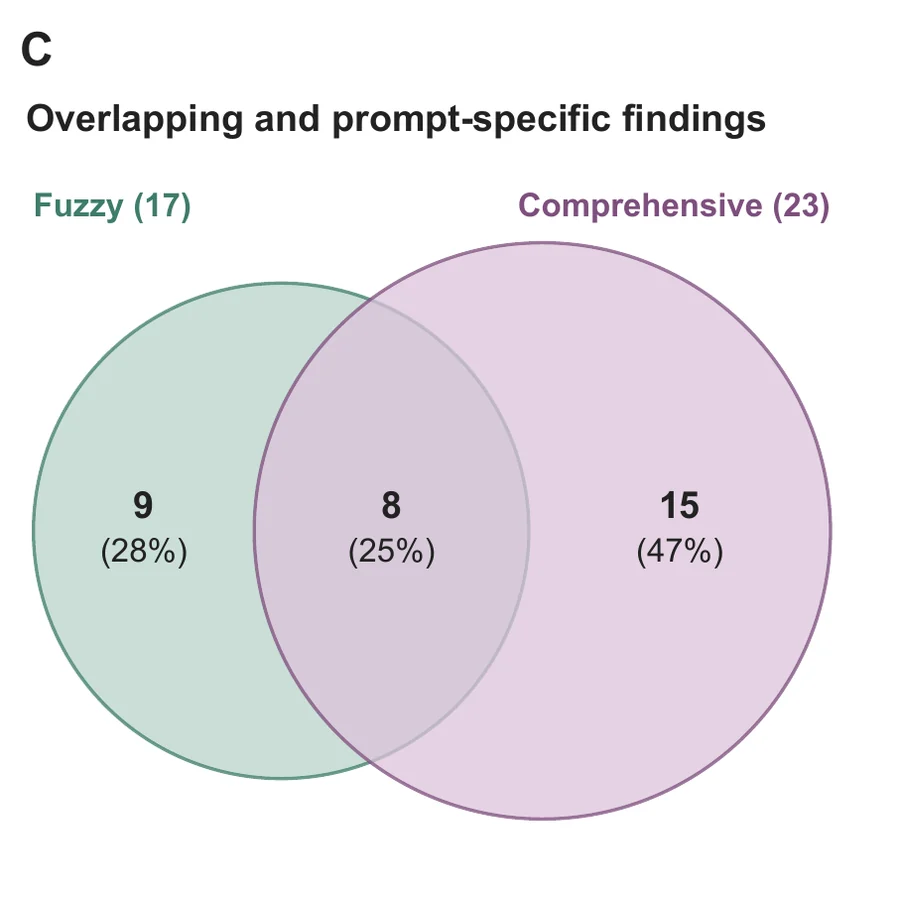
The fuzzy run reported 17 findings and the comprehensive run 23. Of 32 distinct findings, 8 were shared (25%), 9 came only from the fuzzy prompt (28%) and 15 only from the comprehensive prompt (47%).

Of 32 distinct findings: 9 only from the fuzzy prompt, 8 shared, 15 only from the comprehensive prompt.

Only the fuzzy prompt (9)

  • Per-donor fibroblast–macrophage coupling: r = 0.494 in lung (54 donors), r = 0.485 in kidney (42 donors)
  • Three kidney dataset versions to separate an annotation artifact from biology
  • Single-nucleus data compress matrix-gene differences; the coupling metric is robust to this
  • Literature synthesis of 33 references
  • Scar-associated TREM2+CD9+ macrophages recovered in liver cirrhosis

and 4 more

Shared (8)

  • Fibroblast ECM genes up across organs
  • SPP1+/TREM2+ macrophage state exists in several organs
  • Lung carries the strongest signal
  • Liver is underpowered
  • Kidney data pose annotation and platform problems
  • Organs integrated separately, never in one joint embedding
  • TGF-β1 signaling is involved but not simple
  • Myofibroblast expansion is detectable but nuanced

Only the comprehensive prompt (15)

  • Heart and skin data
  • APP–LRP1 endothelial-to-fibroblast signal in 4 of 4 organs tested, with spatial support in lung (permutation p = 0.004)
  • ACTA2, the classic myofibroblast marker, is not conserved across organs
  • A conserved core of SULF1, COL3A1, COL8A1, THBS2, NRP2 and SKI
  • Conservation weakens step by step from genes to programs to circuits to spatial niches

and 10 more

5 The lesson

Stricter, expert-specified criteria overturned a looser exploratory claim

OmiCairn did not need a full protocol to start. But a confident headline from an exploratory prompt is a hypothesis, not a result.

  1. Exploratory prompts are useful for breadth

    From one sentence, OmiCairn chose datasets, built signatures and corrected itself across three kidney datasets. It recovered the main matrix signal and contributed 9 findings the expert prompt did not.

  2. Their headline claims need verification

    The fuzzy run’s “conserved niche” rested on three organs and no spatial data. With heart, skin and spatial tests added, the macrophage and niche claims were not supported.

  3. Experts change the answer, not only the depth

    The expert prompt defined what “conserved” must mean before any analysis ran. That definition is what turned an implied niche into a tested, and failed, hypothesis.

6 Limits

What this case does not show

  • One pair of runs. This is one question asked two ways, not a benchmark of prompting styles.
  • Counting findings is a judgment. The 17, 23 and 8 depend on how findings were itemized and matched (same cell type, program and direction).
  • Spatial evidence is thin. The niche test rests on lung and skin, which point in opposite directions. A kidney spatial dataset had no usable coordinates.
  • Lung dominates. Lung is the best-powered organ and drives much of the cross-organ signal in both runs. Effect sizes for many genes are highly heterogeneous across organs.
  • The fuzzy run’s coupling signal may still matter. Fibroblast and macrophage fractions do rise together across donors in lung and kidney. That may reflect a shared injury response; it is not evidence of a conserved, co-localized niche.
  • Targets are unverified. Druggability in the comprehensive run’s target ranking was curated and flagged for verification.
  • No experiments. Everything here is computational and hypothesis-generating. It has not been validated in the lab.

7 Figure

Figure 6 from the OmiCairn manuscript

Panels A to C are shown below. Panel D is not shown as an image; its content is restated in the agreement table above.

Figure 6 panels A and B. Panel A: a shared research question about conserved cellular programs or universal fibrotic niches across human organs, split into a fuzzy prompt (broad question, no predefined hypotheses, open dataset selection; 3 organs, about 575k cells, limited spatial validation; conserved niche inferred, lower mechanistic resolution) and a comprehensive prompt (five predefined hypotheses, cross-organ design, spatial validation required; 5 organs, 2M cells, 44k spatial spots; evidence-ranked programs, organ-specific context retained). Panel B: a table grading five programs by conservation, spatial support, cell specificity, druggability and priority. Fibroblast ECM core, the COL3A1/SULF1/THBS2/COL8A1 matrix module and the APP-LRP1 endothelial-fibroblast circuit are high priority; the NRP2/SULF1/SKI regulatory core is medium-high; the SPP1/TREM2 macrophage program is recurrent or heterogeneous with weak or contradictory spatial support and medium priority.
(A) The two prompting regimes: input specificity, executed data scale and headline interpretation. Green marks the fuzzy prompt, purple the comprehensive prompt; red labels mark intermediate stages of the fuzzy workflow. (B) Evidence-graded prioritization of fibrotic programs across human organs; shaded cells mark high conservation or priority and strong spatial support. Panel A says “Limited spatial validation” for the fuzzy prompt; Figure 6D records that no spatial data were analyzed. Panel B lists the SPP1/TREM2 macrophage program as recurrent and heterogeneous, not conserved. Figure from the OmiCairn manuscript (in preparation).
Figure 6 panel C: area-proportional Venn diagram of findings. Fuzzy prompt 17 findings, comprehensive prompt 23. 9 fuzzy-only (28%), 8 shared (25%), 15 comprehensive-only (47%), as percentages of 32 distinct findings.
(C) Overlap between the findings of the two prompts (area-proportional; percentages are of the 32 distinct findings). Figure from the OmiCairn manuscript (in preparation).

8 Sources

Data sources

This page
The OmiCairn manuscript (in preparation): Results, Case 2, and Figure 6. The prompt text and the finding-level comparison come from the manuscript’s supplementary materials for Case 2 (the two prompts, and a side-by-side comparison of the two final reports).
Comprehensive run
10 public datasets: 6 from CZ CELLxGENE and 4 from GEO; 7 single-cell or single-nucleus and 3 spatial.
Fuzzy run
5 dataset versions across lung, liver and kidney, including the liver cirrhosis atlas GSE136103, a CD10-negative sorted kidney single-cell dataset, and kidney single-nucleus data from the Kidney Precision Medicine Project.
Status
Hypothesis-generating; not validated experimentally.