Case studies
Three case studies
The campaign shows OmiCairn at scale. These three cases from the OmiCairn manuscript show it up close, each in a different setting: an open-ended question, the same question asked two ways, and an expert reviewing successive rounds. All results are hypothesis-generating.
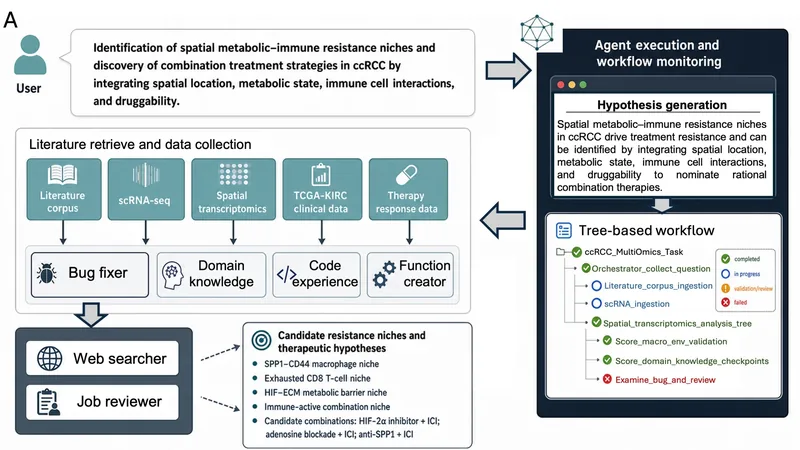
Case 1 · ccRCC
Spatial hypotheses for treatment resistance in clear cell renal cell carcinoma
From an open-ended question, OmiCairn combined single-cell (n = 19), spatial (n = 24) and TCGA-KIRC (n = 613) data and nominated candidate resistance niches.
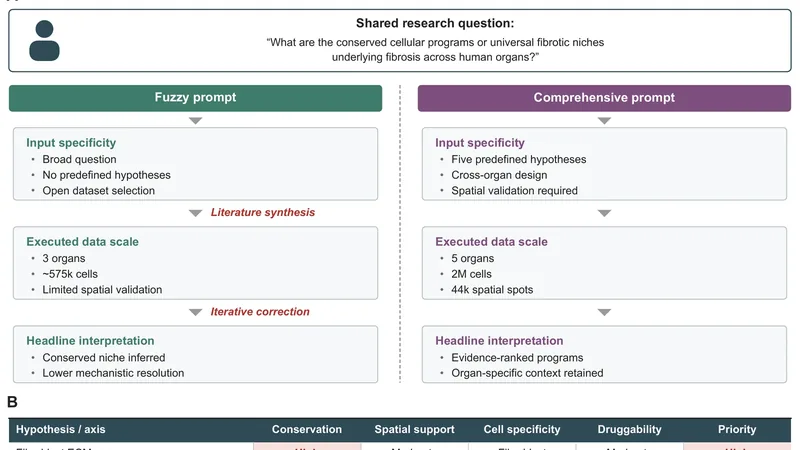
Case 2 · Fibrosis
A fuzzy and a comprehensive prompt for the same fibrosis question
Both recovered conserved fibroblast matrix programs. They disagreed on the macrophage program and the three-cell niche; only 8 of 32 distinct findings were shared.
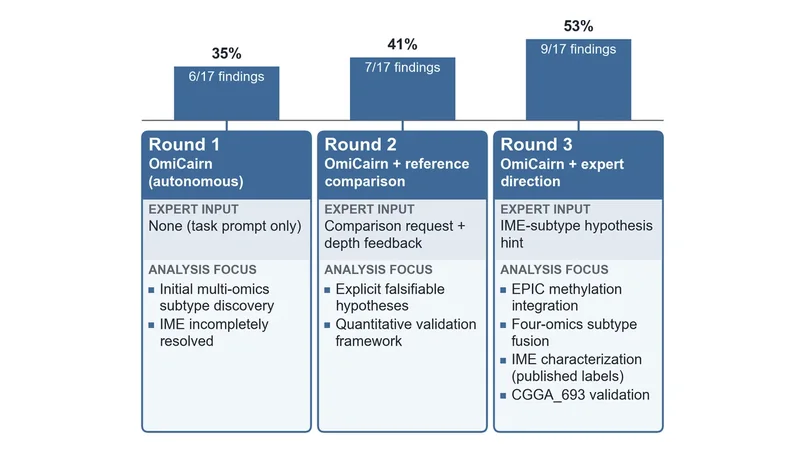
Case 3 · Astrocytoma
Expert feedback rounds raise concordance with a reference study
As expert input grew over three rounds, concordance with 17 reference findings rose from 6/17 to 7/17 to 9/17. The gain measures use of feedback, not autonomous ability.
The cases side by side
| Case 1 · ccRCC | Case 2 · Fibrosis | Case 3 · Astrocytoma | |
|---|---|---|---|
| Setting | Open-ended hypothesis nomination | The same question as a fuzzy and as a comprehensive prompt | Expert review against a reference study, over three rounds |
| Data | Single-cell (n = 19), spatial (n = 24) and TCGA KIRC (n = 613) | Fuzzy: about 575,000 cells, 3 organs. Comprehensive: 2 million cells and 44,000 spatial spots, 5 organs | Public CGGA subset CCell_4083: 35 samples, five omics layers |
| Human input | One open-ended prompt | Two prompts; the comprehensive one required competing hypotheses (the run tested five) and spatial validation | Task prompt, a comparison request with feedback, one hypothesis hint |
| Key result | Resistance niches and follow-up strategies nominated for testing | 8 of 32 distinct findings shared; the prompts disagreed on the macrophage program and the niche | Concordance 6/17 → 7/17 → 9/17; 8 reference findings not recovered |
| Check outside OmiCairn | Multiplex immunofluorescence as a protein-level assessment | Comparison of the two prompts’ findings | Evaluators from the reference study team |
From the Results section and Figures 5–7 of the OmiCairn manuscript (in preparation).